Protocol and Economy
Protocol and Economy
Core Concepts Overview
The mechanics that make token creation on Forest flexible, programmable, and predictable.
FOREST is built on a set of mechanics that work together to make token creation flexible, programmable and predictable. This page explains the concepts you will see throughout the docs and how they interact when a token is launched inside the protocol.
Forest Protocol is a modular creation protocol on BNB Chain. Every part of a token — supply, pricing, staking, games, rewards and more — is configurable by the creator.
1. Token Structure
Every token launched on Forest Protocol has a fixed supply of 1,000,000,000 tokens. Supply does not inflate or change after launch. What creators control is how that supply is distributed and what mechanics operate around it — fees, buybacks, burns, staking rewards, and game vaults.
- Fixed supply: 1B tokens per launch
- Deflationary mechanics available through burns and buybacks
- Supply allocation is fully configurable at launch
2. Bonding Curves & Graduation
First permissionless launchpad with customizable bonding curves. The curve defines how token price moves during the early stage of its lifecycle.
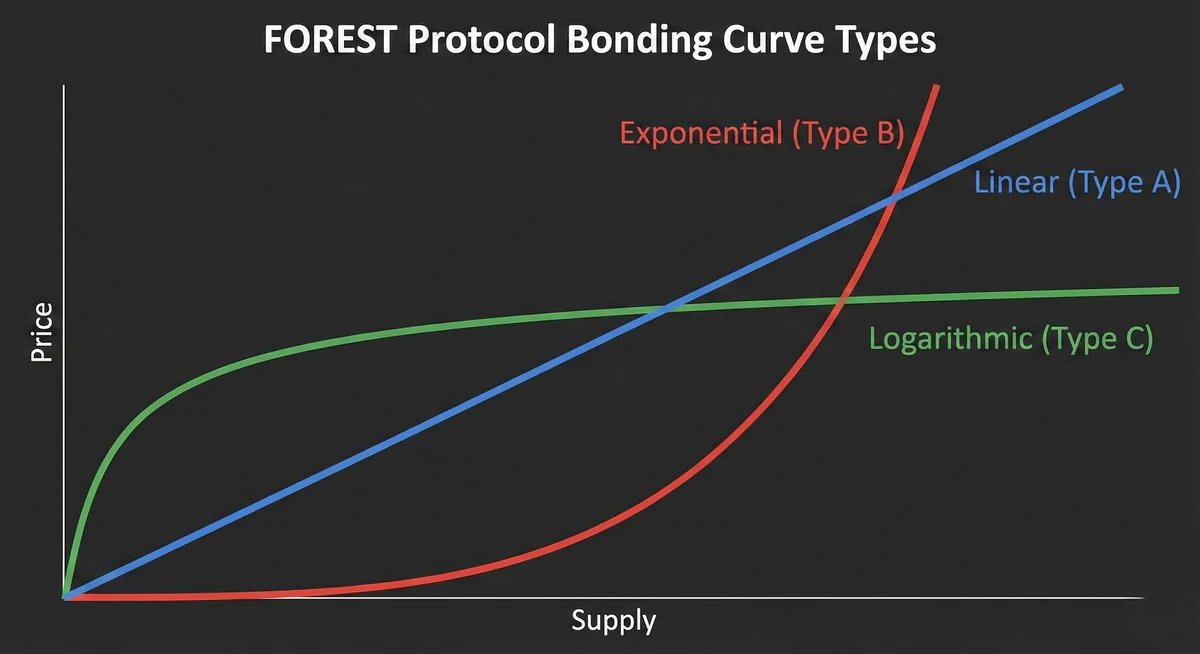
Curve Types:
- Linear — Steady price increase per buy. Predictable, transparent. Best for straightforward launches with no surprises.
- Logarithmic — Fast initial ramp that stabilizes over time. Rewards early participants while keeping later entries stable.
- Exponential — Slow start, steep acceleration as demand builds. Rewards patience and conviction.
3. Liquidity System
Liquidity is the backbone of every token launched in FOREST.
Every token launched on Forest Protocol is paired with $FOREST liquidity from the first trade.
The token begins on the bonding curve selected by the creator. The curve enables early price discovery and steady liquidity growth. No LP bootstrapping needed — virtual liquidity is live instantly.
4. Fees & Buybacks
Fees play a central role in how tokens behave in FOREST. Creators define both buy and sell fees, expressed as percentages.
Fees can route value in different ways:
- to project treasury
- to the protocol
- to automatic buybacks
- to burns
- to reward pools
5. Staking & Reward Mechanics
Forest Protocol has two staking layers — protocol-level $FOREST staking and project-level token staking. Both are native. No third-party contracts. No extra setup.
Staking $FOREST is the core participation mechanic of the protocol:
- Earn APY on staked $FOREST (variable, based on staking duration and total staked)
- Earn Seeds — the off-chain currency used to claim token rewards through Seed Vault auctions
- Longer lock durations earn higher multipliers on both yield and Seeds
- Duration options: 1, 3, 6, 9, 12 months
6. $FOREST & Seed Economy
The native token and liquidity backbone:
- Every token launched is paired with $FOREST
- Every trade routes through it
- Every fee and buyback touches it
- It's the value layer everything sits on
7. Trading Environment
The trading interface adapts based on the token's current state.
During Curve Phase: Trades follow the bonding curve formula.
After Graduation: Trading follows the liquidity pool balance.
Visible to users at all times:
- Current price
- Liquidity depth
- Fees
- Recent trades
- Buyback activity
- Tokenomics overview
Full transparency. Anyone can understand how a token behaves at a glance.
8. Creator Control & Finality
Before publishing, the creator can modify all configuration settings.
Once published, the token becomes immutable:
- Tokenomics are frozen
- Fees and routes are locked
- Distribution cannot be changed
Forest gives creators full flexibility before deployment, and users full predictability after.